
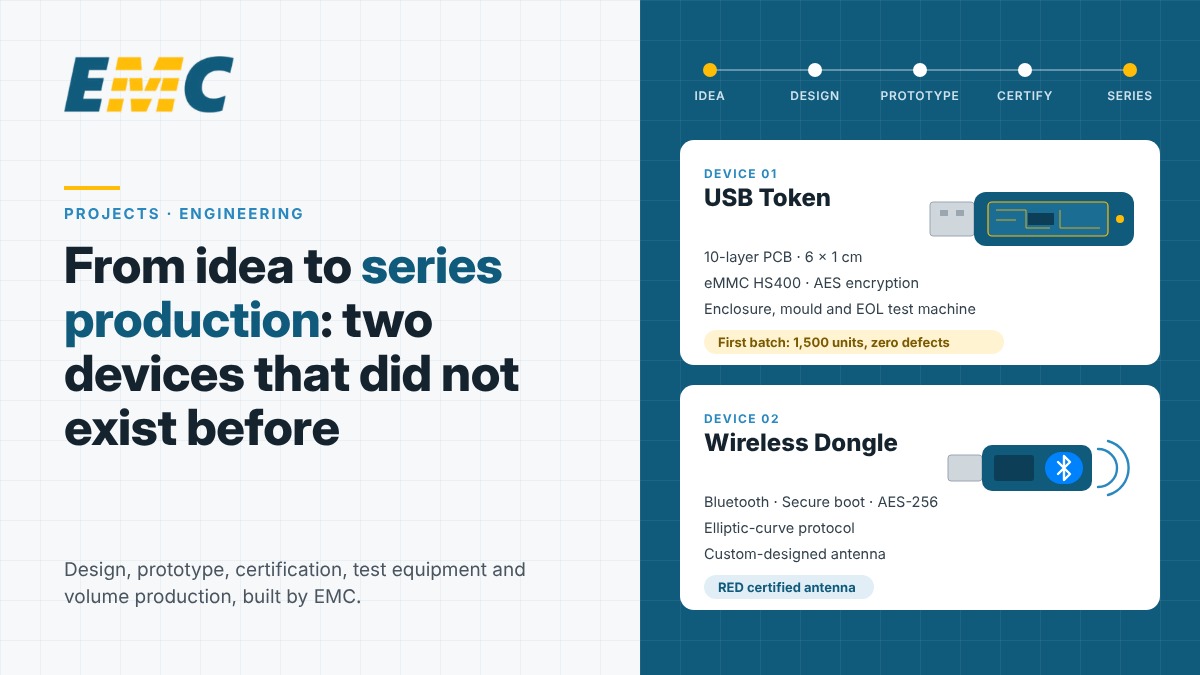
Many of the products we build did not exist when the customer first called us. There was a requirement (a size, a security level, a radio range, a cost target) and no design behind it. Our job was to take that requirement all the way to a box of finished, tested units. Two recent projects show how the chain works. Both are under NDA, so we describe them without naming the customers.
Project 1: a USB security token
The requirement: a compact USB device for secure cryptographic applications in telecom security, able to encrypt data with AES, small enough for everyday handling and robust enough for volume production.
What we designed:
- The electronics, on a 10-layer PCB of only 6 × 1 cm, with impedance checks to guarantee signal integrity.
- A processor sized for cryptographic operations, with integrated RAM and eMMC HS400 storage for fast and secure data processing.
- Firmware and low-level software.
- A custom plastic case and the injection mold to produce it.
- A dedicated end-of-line (EOL) test machine, so that every unit leaving the line is tested in exactly the same way.
The result: the first production batch of 1,500 units was delivered with zero faults.
Project 2: a secure wireless dongle
The requirement: a compact, cost-effective wireless device for portable storage and data logging, with security strong enough for demanding sectors such as banking and finance.
What we designed:
- Electronics with secure boot and an AES-256 crypto engine.
- An elliptic-curve based protocol that keeps data encrypted and protected during wireless transfers.
- A fully custom antenna, designed for wireless performance in a minimal footprint and certified under the Radio Equipment Directive (RED).
What the two projects have in common
In both cases one team owned the whole chain: electronics, firmware, mechanics, molds, test equipment and production. That matters more than any single step.
- Design for manufacturing from day one. The engineers who design the board also design the fixture that tests it and work with the line that builds it, so testability and assembly are decided at the schematic stage, not discovered at the first batch.
- Test equipment designed in-house. Every product gets its own test fixture and end-of-line station, so prototypes and production units are checked with the same criteria.
- Mechanics and molds under the same roof. Case, mold and electronics are designed together, so the product fits, assembles and survives the field as one object.
- One partner, one responsibility. No hand-over between a design house, a mold maker and a contract manufacturer, and no gaps between their specifications.
Is your product still an idea?
EMC designs what it builds: from concept, R&D and prototypes to test equipment, molds and volume production of complex electronic devices that do not exist yet. One partner, one chain. If you have a requirement and no design yet, tell us about it.